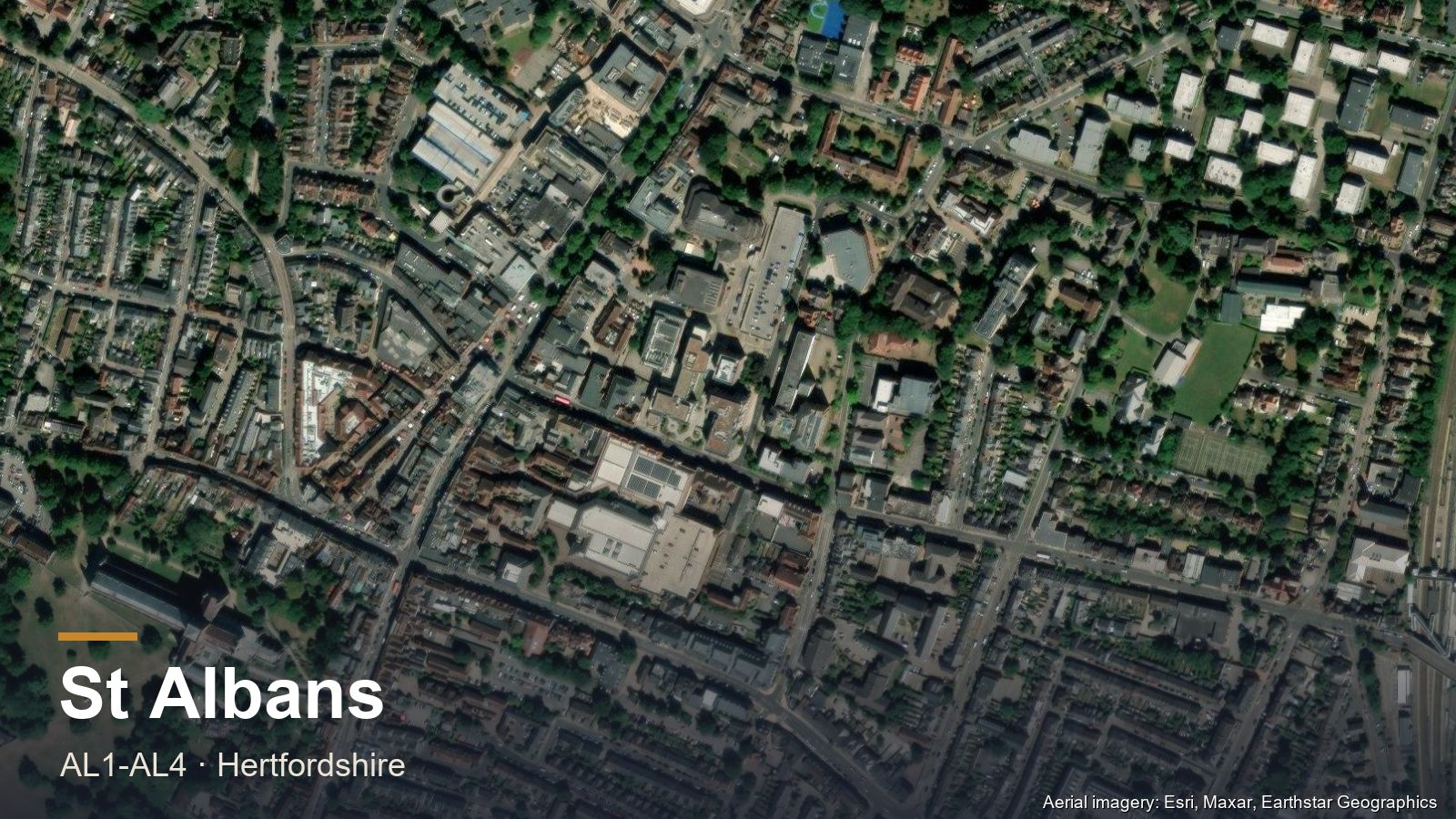
St Albans AL1/AL3/AL4 is one of the largest and most varied Hertfordshire towns Herts Build covers — a Roman and medieval city core, Georgian townhouses, Victorian terraces, and substantial interwar semi-detached suburbs. Sixteen separate conservation areas cover the city, including the Cathedral, Romeland, Sopwell and Fishpool Street.
St Albans housing stock. Marshalswick, on the east side of the city, is dominated by 1930s interwar semi-detached houses — the closest match in St Albans to the Barnet housing stock Herts Build knows best. Fleetville has denser Victorian terraced streets. The historic core around Holywell Hill, the High Street and St Peter’s Street is largely Georgian townhouses with uniform building heights, and George Street near the Cathedral retains medieval timber-framed buildings on narrow burgage plots — both heavily protected.
Extensions in St Albans. Marshalswick’s 1930s semis take standard single-storey rear kitchen extensions comfortably under permitted development, much like the equivalent Barnet streets. Fleetville’s narrower Victorian terrace plots are usually better suited to a side-return extension.
Lofts in St Albans. Marshalswick’s 1930s semis are strong dormer and, where hip-roofed, hip-to-gable candidates. Fleetville’s Victorian terraces suit an L-shaped dormer using the full width of the original rear addition roof.
St Albans Planning Context
St Albans is administered by St Albans City and District Council. The city centre was first designated a conservation area in 1969, and there are now sixteen conservation areas across the district including the Cathedral, Romeland, Sopwell and Fishpool Street — alterations within these are far more restricted than in Marshalswick or the wider suburbs. The specialist checks conservation status and, on listed streets, Article 4 restrictions on the survey.
Frequently Asked Questions
Which St Albans neighbourhood suits which loft type?
Marshalswick's 1930s semis suit dormer or hip-to-gable conversions, similar to equivalent Barnet streets. Fleetville's Victorian terraces are usually better suited to an L-shaped dormer that uses the full rear-addition width.
How many conservation areas does St Albans have?
Sixteen, including the Cathedral, Romeland, Sopwell and Fishpool Street conservation areas around the historic core. The city centre was first designated in 1969. Alterations here are far more restricted than in the suburban areas.
Which council handles planning in St Albans?
St Albans City and District Council — a different planning authority to Barnet, Hertsmere and East Herts.
What extension suits a Fleetville Victorian terrace?
A side-return extension typically works better than a full-width rear extension on Fleetville's narrower Victorian terrace plots, similar to the terraced streets in Hertford and Bishop's Stortford.
Before You Commit
Three separate approvals govern most building work and they are routinely confused. Our guide to planning permission in Hertfordshire covers which council decides and what falls under permitted development. Building regulations are a different approval entirely — needed for almost all structural work even when no planning permission is required — and if the job touches a shared wall or involves excavation near a boundary, you will also need a party wall agreement.